Pocket Perfection

Pocket Doors are perhaps some of my favorite architectural features. Originally, they were often used to separate double parlors which were prevalent in both Victorian and Greek Revival town homes throughout the 19th century. Built in 1832, the Greek Revival Merchant’s House on East 4th Street in New York, boasts beautiful double parlors separated by large mahogany pocket doors.

Pocket doors are still quite prevalent in architecture today, they are a nice feature when a homeowner is looking for an “open plan” and yet wants to be able to create privacy at times. As in the photo above, they also don’t have to be solid.
The doors allow for diverse spatial organization, which is so great.  In the summer, the doors can be kept open for a more airy feel, and then in the winter, close the doors and cozy up next to the fire. I love these doors in Katie Ukrop’s house in Richmond, VA, they are absolutely stunning. The many panes in the doors draw your eye across and through the living room to the the windows at the end.

Albeit chic, what I love about pocket doors is their practicality. Pocket doors do not get in the way, they never swing closed when the wind blows through your house or apartment, they don’t have to be propped open, and they take up no floor space.
In  my tiny fifth-floor walkup in NYC, I had pocket doors on both the bathroom and bedroom doors.  In such a tiny rabbit warren type space, pocket doors were great because they didn’t take up any of the all important space!  They are especially great for bathrooms–in my NYC space, had there not been a pocket door, the bathroom door would have swung outwards and hit the stove.  
Closets can also be another great opportunity to utilize pocket doors because of their space saving attributes! 
Although originally intended to separate gracious spaces, as in this living room/dining room by Ashley Whitaker from House Beautiful, pocket doors can be extremely useful when trying to design smaller, practical spaces. 

More Architecture

Objet of my Affection

Cottage Living
After some feedback from my friends about Friday’s post, it occurred to me that when it comes to tablescapes and mantlescapes, not many people know where to go looking for decorative objet to do their “scaping.”  At the end of my post, I complained about Nate Berkus’ collection on HSN.com which features  pre-packaged mantlescapes and tablescapes.  Obviously there is a reason that Berkus has included those items in his collection for the bargain website–clearly people don’t know what objet to use, where to go looking for them, and how to put their “scape” together.  To my loyal readers, I am sorry that I have left you high and dry!  
Above is the first tablescape that I ever put together on my own.  I was extremely proud of myself, as my mother is quite the “tablescaper.”  I did this in the house in Charleston.  However, this tablescape did not come together all at once, it came together very slowly over time. 
Prior to the purchase of the mercury lamp, and the magnolia painting, the space had not realized its full potential.  A tablescape has a pretty basic formula: a lamp, possibly a plant or floral arrangement, a few objets, books, and some photos.  Also if your table has spindly legs, it is nice to anchor it with something, as I did with the jardiniere in the preceeding photos.  
Domino
House Beautiful
House Beautiful
Cottage Living
Choosing the right objet, books, lamp etc. and putting them in order is up to you!–however, I do have some suggestions on where to buy good objet and accessories for your tablescape.
Z Gallerie boasts a quite a few objet for your “scaping” projects, however, make sure you choose wisely.  There are a few things on the website that are a little too ostentatious for many decorating schemes.  The three objets pictured above are all under $40, and would make a great addition to a side table, cocktail table, or bookshelf.  


Albeit a tad more expensive, RSH.com offers some beautiful, more conservative objet for under $100.  One can never go wrong with blue porcelain, it is a classic–I even used it in my first tablescape!  I love the Casablanca lanterns, I have something similar in my apartment, and the light from the candles will make beautiful shapes on your walls.  Foo dogs have been quite popular for some time now, but I love these because they forego the traditional blue in favor of a funkier and more contemporary lime.  

CB2, the perennial favorite when it comes to cheap home decor solutions, offers quite a few items that will work well.  A few of my favorites are above.  I love architectural elements in tablescapes, like the magnificent tabletop staircase model in Bill Blass’ Connecticut House–talk about lusting after something!  Since I cannot afford an antique staircase model, the stick sculptures of buildings will have to do.  They are great looking, and will add height to any “scape.”  The format tray is a must have … I think a tray is one of the best things in a tablescape–stack some books on the tray with an objet on top and you are pretty much finished.  The best part about trays is, when friends come for cocktails, just remove your books and objet and add some liquor and you have a ready made bar!  I love the colors and shapes of these citrus vases, and what a price! 
                                                                   

This is one of my absolute favorite objet out there, and something that I have recently begun to think that I must purchase.  This is a  lacquer bath box from Jonathan Adler.  What a sneaky place to store miniature treasures, or perhaps even jewelry.  This turquoise color is my favorite, but it comes in a variety of other chic and cheerful colors.   
 Domino
Above I have offered some suggestions on certain objet to complete your tablescape or mantelscape or bookshelfscape–go for it! 

More Finds

I Wish I had a …

Fireplace! Since I have just gotten back from Charleston, land of the amazing extant 18th and 19th century houses, I have been thinking about fireplaces–and more specifically, fireplace mantels. Unfortunately, I have neither. For those apartment dwellers and homeowners who are lucky enough to have a working fireplace to cozy up to during this recent drop in temperature–I envy you. And for those of you living in an apartment building or converted townhouse that has a mantelpiece as a reminder of what once was a working fireplace–I am equally jealous.
Canadian House and Home

Miles Redd

Southern Accents

Nick Olsen, Domino
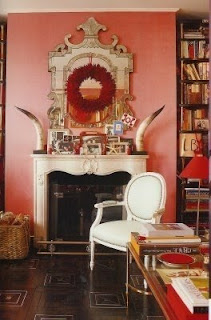
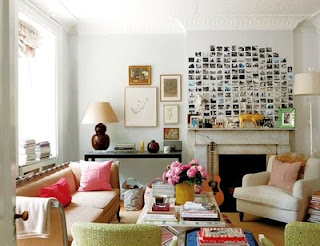
Working or non-working, a fireplace provides a great focal point for any room, and an opportunity to create a mantelscape. Books, candles, flowers, photos, objet and in Miles Redd’s case, horns, are all great for decorating a fireplace mantel. Some prefer allowing the architectural details of the mantelpiece stand alone, such as Nick Olsen above, and some Charlestonian mantels below.
75 King Street, carriageprop.com

90 Church Street, carriageprop.com

There are also non-traditional mantelscapes. Charlestonian and jewlery designer, Janet Gregg, did an off center mantelscape in her Stolls Alley cottage that plays off the rambling nature of her 18th century house. Rita Konig, our favorite Domino contributor, used her mantelpiece as an opportunity to display photos in an unconventional way.
Janet Gregg, Cottage Living

Rita Konig, Domino

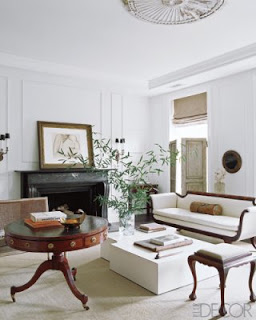
Some prefer to stick with one single object above their mantel whether it is hanging or leaning a painting or a mirror–this option works too.

Darryl Carter, Elle Decor

Domino

The most important thing to remember is that it should be personal! Nate Berkus is currently selling “mantelscapes” on hsn.com. I think that part of the fun of decorating things like mantels and tables is using things that you already own to create a personalized vignette. Sure, there is definitely a popular formula, but don’t purchase a pre-packaged decorating scheme just so you can have a finished mantel. None of the items need to be expensive–as in Rita Konig’s apartment, she used printed photographs to create her mantelscape. And if you are using a single painting or mirror, that can also be cheap! I cannot wait until I have a mantel of my own to decorate–fire or no fire.

More Architecture